
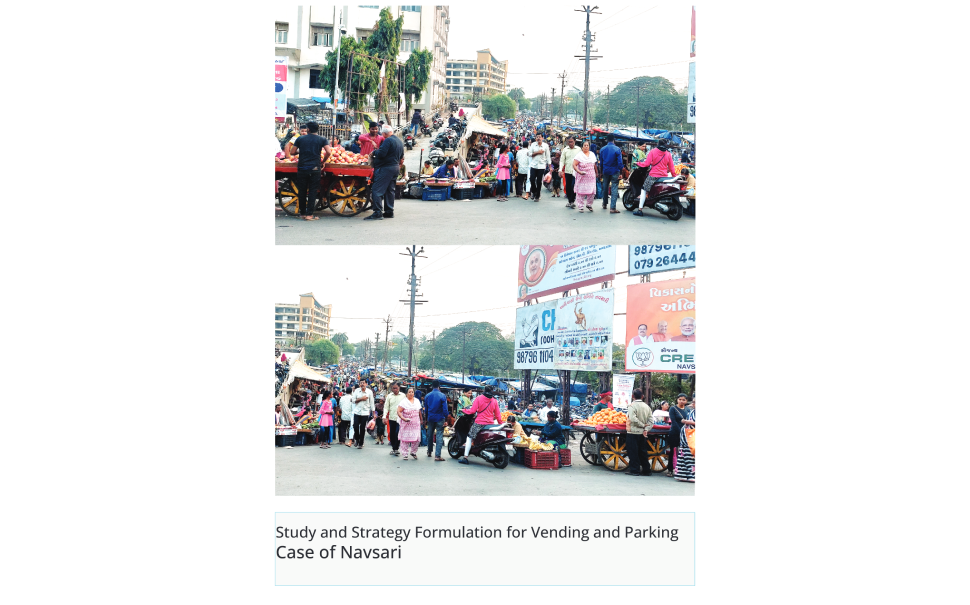
Study and Strategy Formulation for Vending and Parking – Case of Navsari
Vending and parking within the public realm and streets are closely linked. When unorganised, this combination leads to congestion, traffic, and blocked pedestrian pathways. The National Urban Livelihood Mission (NULM) addressed the concerns of urban street vendors through the Street Vendor's Act 2014. Within larger cities there are guidelines and ULB efforts to implement them for vending and parking. The core problem is the absence of norms and guidelines for public parking within the Right of Way, and for developing dedicated parking plots. This gap is especially acute in smaller and medium-size cities, which lack the resources and precedents that larger cities have to find contextual solutions. The problem is further compounded by rising vehicle ownership per household and growing population.
Through the study of Vending and Parking in Navsari, a medium-sized city, the research aims to identify the challenges and opportunities and to suggest strategies and guidelines that ULBs can implement. The main objectives of the study are to identify and document existing models of development and management for vending and parking, especially in commercial areas, to identify and assess the demand and supply of vending and parking area, and to identify the challenges and potential for their development and management. A study of this kind can act as a reference point for other small and medium-sized cities facing similar gaps.
The study used a mix of qualitative and quantitative analysis to document and understand the problems in depth within the selected areas. Some of the questions that guided our method were: What is the existing condition of vending and parking areas across commercial and mixed-use streets in Navsari? What is the existing situation with regard to vendors and vending area? What is the quantum and duration of vending and parking with respect to adjoining activity zone and building use? What quality and quantity of areas are provided for parking versus the building bye-laws? What are the challenges faced by stakeholders, and their willingness to pay for vending and public parking spaces?
To assess the current situation, 16 areas were documented through photos and on-site interactions with users, of which 4 areas were selected for in-depth study. The study uses case studies and a review of existing guidelines, then documents the on-site condition through surveys with different stakeholders, governing officials, vendors, shopkeepers, and end-users, to understand the problems from different perspectives. A total of 1.5 kms of streets were documented to assess parking and its users.
Based on this understanding, and the difference between guidelines and implementation, the following recommendations were made. Organised parking requires spatial norms and guidelines. Open space should be provided for dedicated parking plots along major markets. On-street parking should be allowed only for short- and medium-term duration, enforced through an hour-based charging system. Provision of footpath, cycle lane and street infrastructure should be prioritised over on-street parking. Long-term duration parking should be formalised by providing parking within buildings and dedicated parking plots within walking distance. Laws for provision of parking within buildings need to be enforced. Together, these recommendations suggest what ULBs can implement to better manage vending and parking and make streets more walkable and organise.